Structured illumination microscopy (SIM) has become an important technique for live-cell super-resolution imaging, thanks to its low phototoxicity, high spatial resolution, and broad compatibility with conventional fluorescent probes. Most current SIM systems, however, rely on pixelated digital devices such as spatial light modulators (SLMs) or digital micromirror devices (DMDs) to generate and rapidly switch structured illumination patterns. While flexible and fast, these devices also lead to higher system costs, greater control complexity, reduced optical efficiency, and self-diffraction noise.
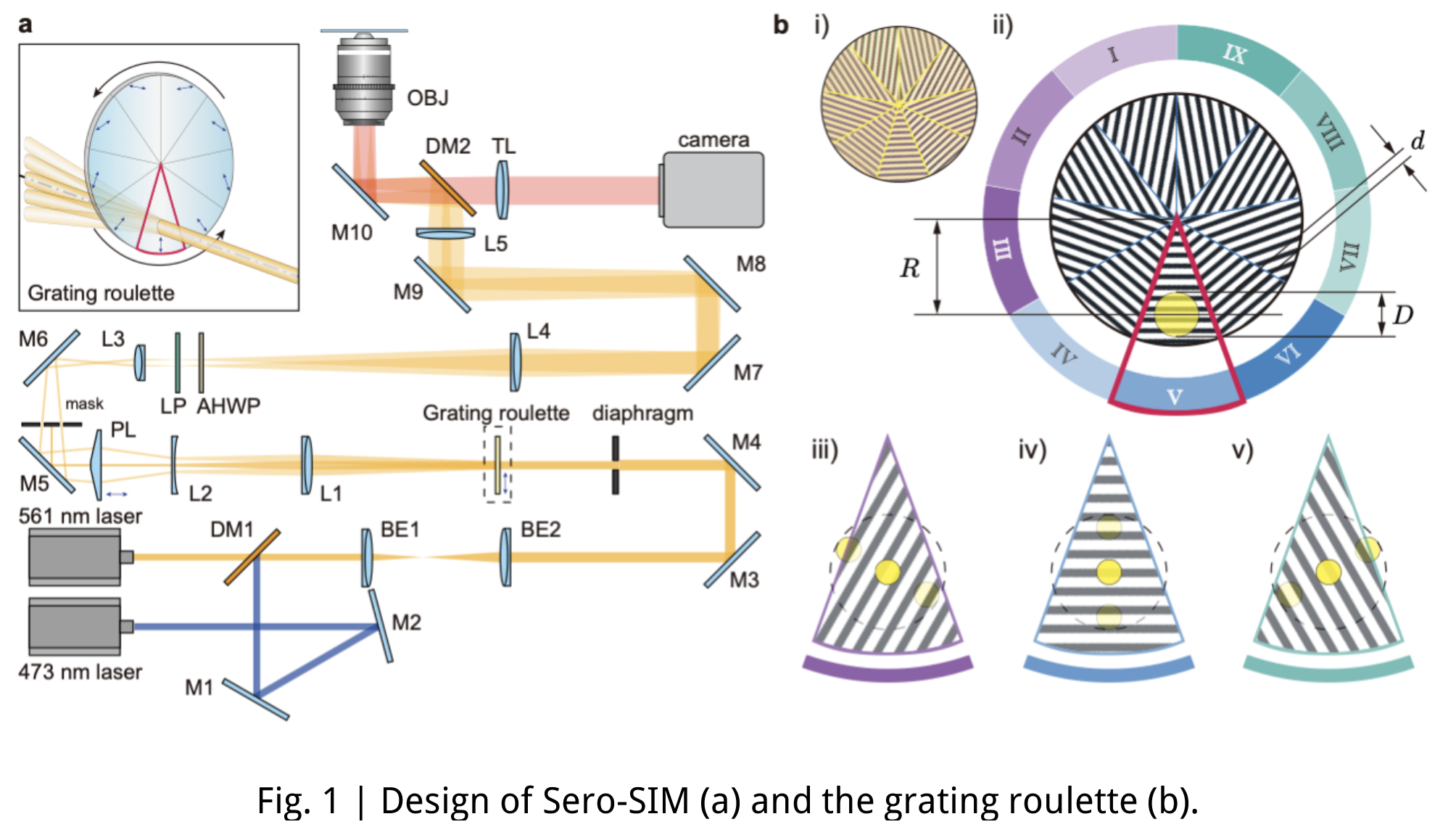
To address these challenges, the research team developed SEctor-ROtational SIM (Sero-SIM), in which two essential modulation functions—switching the illumination orientation and shifting the illumination phase—are integrated into a single transmissive grating roulette. With an exceptionally simple control scheme and low hardware cost, Sero-SIM achieves nearly a two-fold improvement in lateral resolution.
The researchers further incorporated a specially designed pyramidal lens to decouple the size of the grating sectors from the achievable imaging field of view. This expanded the field of view by more than 13-fold, enabling large-field super-resolution imaging over 107 μm × 107 μm with a 100× objective. Sero-SIM demonstrated robust performance in imaging a variety of subcellular structures in both fixed and living cells, offering a simple, low-cost, and scalable SIM platform for multiscale super-resolution imaging—from tissue sections and cell populations to individual cells and subcellular structures.
What’s more, the researchers further introduced a pyramidal lens (Gang Wen et al., Optica 12, 1180–1191, 2025), decoupling the physical grating size from the imaging field of view and greatly increases the spatial throughput of the system. Sero-SIM accommodates super-resolution imaging across different spatial scales, from tissue sections to subcellular structures.
The team validated the system using both fixed specimens and living cells. The results showed that this simplified modulation strategy can reliably produce high-quality super-resolution fluorescence images and is suitable for time-lapse imaging of dynamic biological processes.
Original paper
Han Wang, et al. Sector-rotational structured illumination microscope for large-field-of-view super-resolution imaging. Light: Advanced Manufacturing 7, 121 (2026).